If you send business texts in the U.S. or Canada, part of the cost of every message is set by the mobile carrier your customer uses, not by your messaging provider. Those carrier pass-through fees are small per message and easy to overlook, which is exactly why they deserve their own line when you budget.
Looking for the numbers? Our SMS, MMS & RCS carrier fee reference for the U.S. and Canada lists carrier fees by carrier, sender type, channel and direction, with the date and time it was last updated. This guide explains what those numbers mean.
What a carrier pass-through fee is

Carriers such as AT&T, T-Mobile and Verizon charge a fee for business (application-to-person) messages that cross their networks. Messaging providers pass those fees on to the business that sends the messages, usually in addition to their own per-message rate. The provider does not set the fee; it passes it through, which is where the name comes from.
Why the same message can cost different amounts

Four things decide which fee applies to a message:
- The recipient's carrier. Each carrier sets its own fees, and regional carriers often differ from the national ones.
- Your sender type. Short codes, 10DLC numbers, toll-free numbers and Canadian long codes each have their own fee schedule.
- The channel. SMS, MMS and RCS are priced separately, and RCS fees are set by message tier.
- The direction. Outbound messages (MT, mobile-terminated) and inbound replies (MO, mobile-originated) can carry different fees, and some carriers list a fee in only one direction.
In Canada, check the currency too: some Canadian fees are in Canadian dollars and others in U.S. dollars.
RCS does not get you around carrier fees
RCS business messaging has carrier fees of its own. U.S. carriers bill RCS by tier (Rich, Rich Media and Interactive Session), and several carriers' RCS fees are at or above their SMS fees for comparable traffic. What RCS changes is what a message can do: a branded sender, rich cards, suggested replies and read receipts. That can make each message worth more to you, but it does not make the carrier fee disappear.
A fraction of a cent adds up
Carrier fees are often quoted to four decimal places, which makes them easy to dismiss. Volume changes that. At half a cent per message, one million outbound messages carry $5,000 in carrier fees on their own. Two-way programs add inbound fees where carriers charge them, and a long SMS split into several segments may be charged more than once, depending on how your provider counts messages.
Reading the lines on a messaging bill
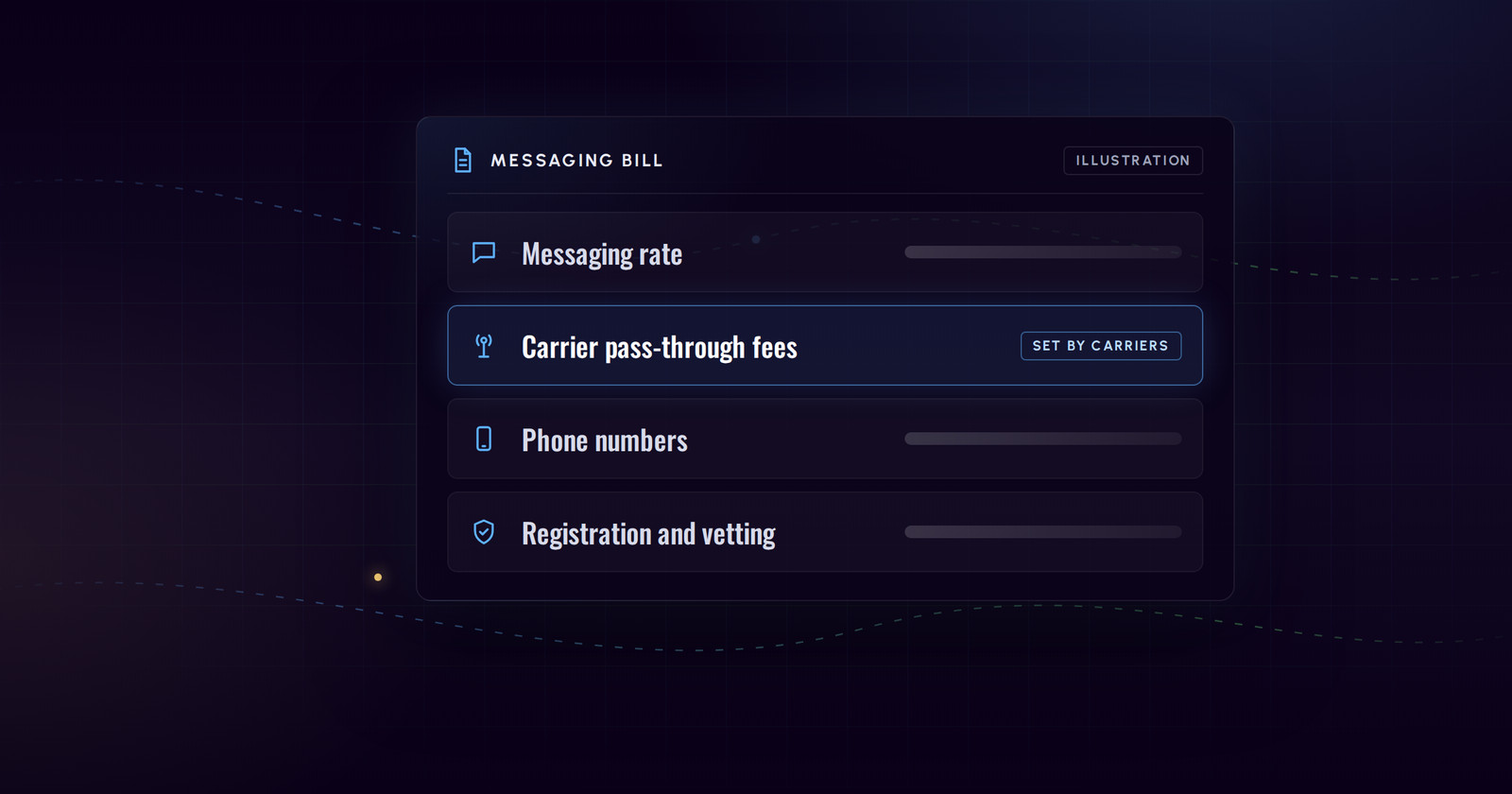
A business messaging bill usually combines four kinds of charges:
- Messaging rate: what your provider charges per message, by channel.
- Carrier pass-through fees: set by the carriers, per message, by carrier, sender type, channel and direction.
- Phone numbers and short codes: per number or code, usually monthly.
- Registration and vetting: brand, campaign and number registrations, one-time or recurring.
Some providers list carrier fees as a separate line; others fold them into a combined rate. Neither is wrong, but you can only compare two quotes when you know which one you are looking at.
Five questions to ask any provider
- Are carrier fees included in the per-message rate or billed separately?
- Which carriers, sender types and directions does the quote assume?
- Are long SMS messages counted per message or per segment?
- Which currency applies to Canadian traffic?
- How will you tell me when a carrier changes its fees?
How Tells quotes it
A Tells quote is built from your real scope: usage, carrier fees, registrations, sender types and support, and it is scoped on a live call instead of printed on a page. Our carrier fee reference is a guide to the carrier fees involved. Carriers can change them, and your quote and account terms set what you are charged.
Want to see how carrier fees apply to your traffic? Get a quote and bring your monthly volumes and the carriers you reach.