Developer evaluation

Tells vs Twilio for developers: how to evaluate the difference

Two providers can both send a text message. The decision is about who owns the work around the send: registration, carrier follow ups, monitoring, and the support relationship when traffic is filtered. This page states what each side publicly documents, cites the sources, and gives you a checklist to run yourself.

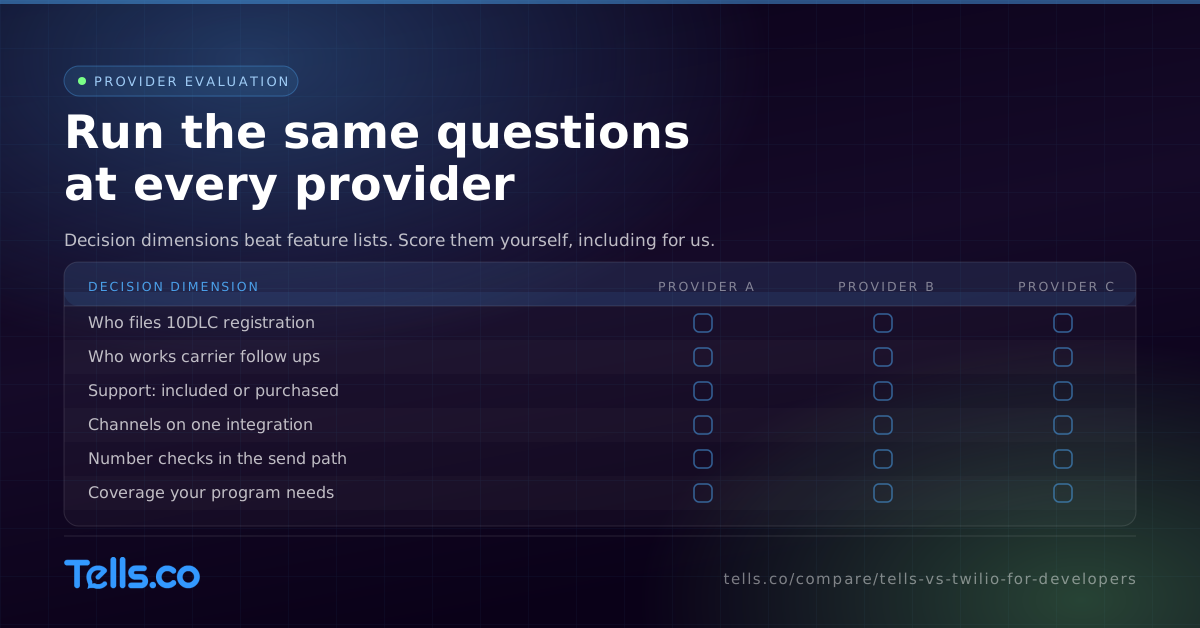
Evaluation matrix listing six decision dimensions such as who files 10DLC registration and who works carrier follow ups, with unscored columns for three providers.

Tells and Twilio solve overlapping problems with different operating models. Twilio publishes a self-serve global platform with public reference documentation, tiered support plans, and self-service registration through Trust Hub. Tells provisions API access per account, focuses on United States and Canada routes, and performs sender registration, carrier follow ups, and program monitoring as part of the relationship. For a CRM or SaaS team, the practical question is whether you want to staff messaging operations or hand them to the provider.

Last reviewed July 27, 2026. Vendor facts accessed July 23, 2026 and cited below. Method: comparison methodology.

Scope

What this page compares, and what it does not

Compared here

  • Access and documentation model, as each provider publicly describes it
  • Who performs United States sender registration and carrier follow ups
  • The support relationship each provider publishes
  • Channel breadth reachable through one integration
  • Geographic focus, at the level each provider publicly states

Deliberately not compared

  • Price comparisons, because Tells quotes per program and totals depend on message mix, sender type, volume, and fees
  • Deliverability, filtering, or delivery rate comparisons, because neither provider publishes figures that could be compared like for like
  • Reliability or uptime comparisons, for the same reason
  • Market share, customer counts, or customer outcomes

Everything attributed to Twilio below is drawn from Twilio public pages recorded in the Tells comparison source register, accessed July 23, 2026. Vendor pages change. Verify before you decide.

Decision dimensions

Where the two providers actually differ

Each row states both positions from public material, then hands you the question that settles it for your program. The answer depends on your team, not on which column looks longer.

How you get access

Tells

Access is provisioned per account. Onboarding issues OAuth2 credentials scoped to your workspace, sets up the environment, and includes a guided first send. There is no public signup flow.

Twilio

Self-serve platform signup, with product documentation published openly on twilio.com.

Verify for your program Does your team need to prototype before a commercial conversation, or is a scoping call acceptable before the first line of code?

Sources: TL7, T3

Reference documentation

Tells

A public overview page describes the supported surface. The complete endpoint reference, request and response schemas, SDKs, Postman collection, sandbox, rate limits, and status codes are provided with account credentials during onboarding.

Twilio

Reference documentation, including messaging and voice webhook documentation, is published openly and can be read before any commercial contact.

Verify for your program Can your evaluation process accept account-gated reference material, or does your architecture review require reading the full reference in advance?

Sources: TL7, T8, T9

Who performs 10DLC registration

Tells

The Tells team prepares, submits, and tracks 10DLC, short code, and toll-free filings, and works carrier review follow ups and requested campaign edits.

Twilio

Registration runs through the Trust Hub console and APIs as self-service. Twilio estimates under one week for campaign approval and states there is no exact timeline.

Verify for your program Who on your team would own registration filings and carrier follow ups, and what does that cost you in engineering weeks per sending brand?

Sources: TL1, T3

Support relationship

Tells

Direct support from the team that runs the program, included in the qualifying account relationship rather than purchased separately.

Twilio

Four published support plans, from a free Developer plan to Personalized at the greater of $5,000 per month or 8 percent of spend, with a named technical account manager in the top tier. Professional Services are priced separately.

Verify for your program What support tier does your program actually require, and is that cost in your build estimate today?

Sources: TL1, T1, T10

Channels on one integration

Tells

SMS and MMS, RCS with automatic SMS fallback, AI SMS and voice agents, call announcements, and number intelligence are reached through one REST surface and one account relationship.

Twilio

Programmable Messaging, Voice, RCS Business Messaging, and conversational AI including ConversationRelay are separate products you integrate individually.

Verify for your program How many of these channels are on your two year roadmap, and what does adding the second one cost in integration time under each model?

Sources: TL3, TL4, T4, T5, T6

Number metadata in the send path

Tells

Carrier and line type, CNAM, and a 0 to 100 activity score are available in real time and usable inside the send path for routing and suppression decisions.

Twilio

Lookup and Verify are separate APIs you call and wire into your own flow.

Verify for your program Do you want number checks as a decision point inside your send service, or as a separate call your application orchestrates?

Sources: TL5, T7

Geographic focus

Tells

United States and Canada carrier routes.

Twilio

Twilio publishes per-country messaging rates across a broad international footprint.

Verify for your program Which countries does your program need in the next twelve months? Confirm that list first, because coverage is a decisive constraint and no other dimension matters if it fails.

Sources: TL1, T2

Pricing model

Tells

Quoted per program based on volume, message type, and number type. No published list rate.

Twilio

Published pay as you go rates, with better discounted pricing available through committed spend or volume.

Verify for your program Compare complete quotes for your actual message mix, including carrier surcharges, registration and vetting fees, support plan cost, and any committed volume, rather than comparing headline per-message rates.

Sources: TL7, T2

Checklist

The evaluation checklist

Run these against every messaging provider you shortlist, including Tells. The answers matter more than any comparison page, including this one.

Access and integration

  • Can we read enough reference material to size the integration before we commit?
  • What does authentication look like, and can credentials be scoped and rotated?
  • Is there one surface for the channels on our roadmap, or one integration per channel?
  • What is the path from credentials to a first successful send, and how long does it take?

The listen path

  • Which lifecycle events are delivered as callbacks, and which require polling?
  • How are inbound messages, replies, and opt-outs surfaced to our system?
  • What are the retry semantics, and what does our handler need to tolerate?
  • How do we verify that a callback genuinely came from the provider?

Registration and compliance

  • Who prepares and submits 10DLC, short code, and toll-free filings?
  • Who works carrier review follow ups and requested campaign edits when a filing stalls?
  • If we send on behalf of customers, how are per-brand registrations handled at scale?
  • How are STOP and HELP handled, and how does suppression state reach our database?

Operations and support

  • When traffic is filtered, who investigates, and is that included or purchased?
  • What response expectations apply to our plan, and what do higher tiers cost?
  • What monitoring do we get, and what are we expected to build ourselves?
  • Who is accountable if the program is live but underperforming?

Commercials and exit

  • What does a complete quote look like for our actual message mix and sender types?
  • Which fees sit outside the per-message rate?
  • Does competitive pricing require a term or volume commitment?
  • If we leave, what transfers: numbers, registrations, suppression lists, consent records?

Honest limits

Where public information runs out

  • Neither provider publishes comparable delivery rate data, so any deliverability claim you read anywhere deserves a request for methodology.
  • Carrier and registry approval decisions remain outside any provider control, including ours, so no provider can promise a registration outcome or a date.
  • Support tier prices change and plans are restructured. Confirm current terms on the vendor page before you build a business case on them.
  • Tells does not publish list pricing, so a like for like cost comparison requires a quote for your program rather than a page you can read.

FAQ

Evaluation questions we are asked directly

Is Tells a drop-in replacement for Twilio?

No integration is a drop-in replacement. The concepts transfer cleanly, because both are REST APIs with webhook callbacks, but endpoints, payload shapes, and callback contracts differ. Expect to rewrite your send service adapter and your webhook handler, and to re-register senders rather than move registrations.

What actually differs for a developer?

The access model and the operational split. Twilio publishes its reference and lets you self-serve, including registration through Trust Hub, with support sold in tiers. Tells provisions access per account and performs registration, carrier follow ups, and monitoring inside the relationship. The code you write is similar. The work around the code is not.

Which one is cheaper?

That cannot be answered generally and this page does not try. Twilio publishes pay as you go rates. Tells quotes per program. Total cost depends on message mix, sender types, carrier surcharges, registration and vetting fees, support plan, and committed volume. Compare complete quotes for your actual program.

We need messaging outside North America. What then?

Coverage is limited to United States and Canada carrier routes. If your program requires reach beyond that in the near term, settle the coverage question before anything else on this page matters.

Can we run both?

Teams do run more than one messaging provider, usually split by region or by traffic type. If that is your plan, design your internal send service as an abstraction from the start so provider specifics stay in one adapter.

Sources (15) and verification dates
  1. T1. Twilio — Support Plans
  2. T2. Twilio — Pricing overview
  3. T3. Twilio — A2P 10DLC registration
  4. T4. Twilio — RCS Business Messaging
  5. T5. Twilio — Conversational AI pricing
  6. T6. Twilio — ConversationRelay docs
  7. T7. Twilio — Verify API overview
  8. T8. Twilio — Messaging webhook request docs
  9. T9. Twilio — Voice webhooks docs
  10. T10. Twilio — Professional Services
  11. TL1. Tells — High-Volume SMS
  12. TL3. Tells — RCS Messaging
  13. TL4. Tells — AI SMS & Voice Agents
  14. TL5. Tells — Number Intelligence
  15. TL7. Tells — Integrations & API

Vendor pages accessed July 23, 2026. This page last reviewed July 27, 2026. Vendor terms and plans change without notice; confirm anything you plan to rely on. Corrections: tells@tells.co.

Get the answers for your program, not a generic comparison

Bring the checklist. A short scoping conversation is how the pricing, coverage, and registration questions get answered for your actual message mix instead of in the abstract.

Prefer email? Developer onboarding runs through dave@tells.co.